
When you need medical care, choosing the right method is vital. In the debate of IR vs Traditional Surgery, many patients now choose Interventional Radiology (IR). This growing preference in IR vs Traditional Surgery is because IR offers major safety benefits compared to open procedures.
But why is IR safer in IR vs Traditional Surgery comparisons? Specifically, IR uses real-time imaging and tiny incisions. Therefore, IR vs Traditional Surgery highlights how IR provides precision and comfort that traditional surgery cannot match.
1. Minimal Invasiveness and Precision
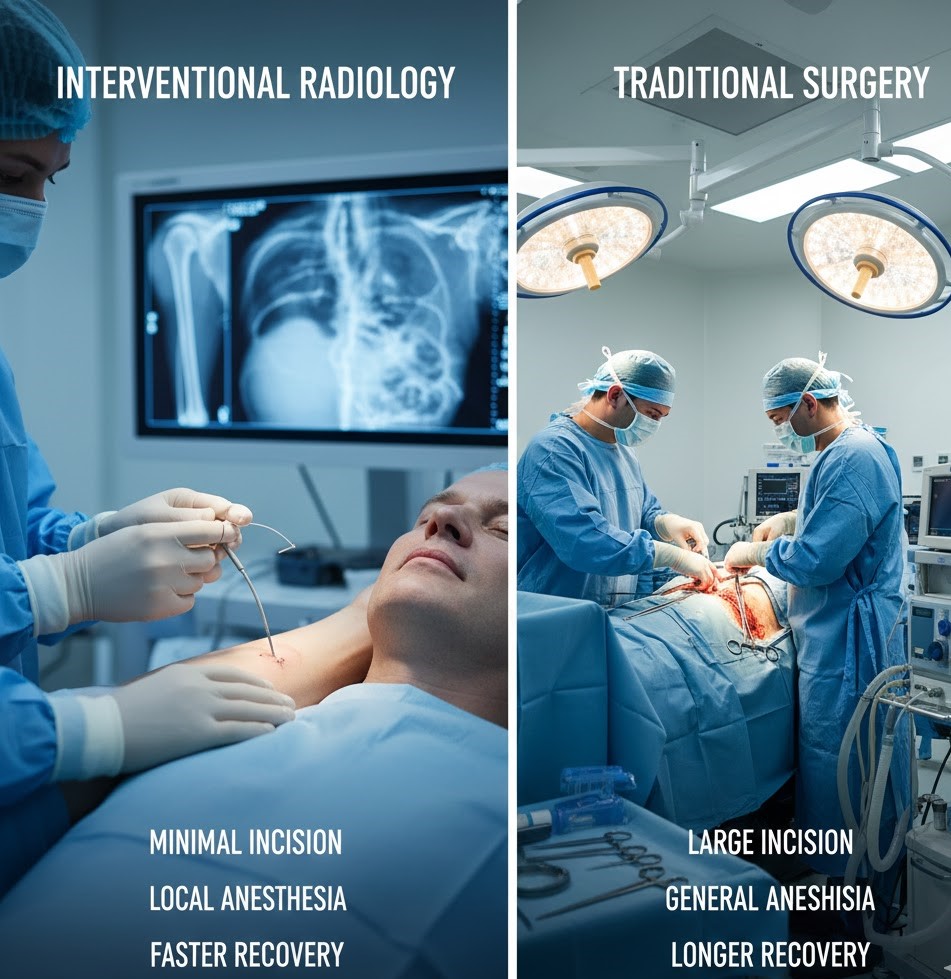
The main difference in IR vs Traditional Surgery is the scale of the procedure.
- Traditional Surgery: Often, surgeons must make large incisions to reach an organ. Consequently, this can damage healthy surrounding tissue.
- IR: IR doctors use a tiny “pinhole” entry point. First, they use high-definition imaging like X-rays or CT scans. Then, they guide thin catheters directly to the problem area.
This method allows the doctor to see the target from the inside. Therefore, it avoids the trauma of cutting through many layers of the body.
2. Lower Risk of Infection
Large surgical wounds can lead to complications. For example, every inch of a cut increases the risk of bacteria entering the body.
However, IR procedures only require a tiny puncture. Because of this, the risk of infection is much lower. Additionally, IR techniques can actually stop internal bleeding quickly. This makes the field a leader in blood-saving care.
3. No Need for General Anesthesia
General anesthesia can be risky for many people. This is especially true for the elderly or those with heart conditions.
- Surgery: This usually requires you to be fully unconscious. Often, you must also use a ventilator to breathe.
- IR: Most IR tasks use local anesthesia or mild sedation.
Consequently, patients stay awake and breathe on their own. This removes the stress that general anesthesia puts on the heart and lungs.
4. Faster Recovery Times
Traditional surgery is a major “insult” to the body. Therefore, it requires a long time to heal. For instance, a surgical patient might stay in the hospital for days.
In contrast, IR patients often go home the same day. Most people return to their normal lives within a week.
| Feature | IR | Traditional Surgery |
| Incision Size | Pinhole (2-3mm) | Large (several inches) |
| Anesthesia | Local or Sedation | General Anesthesia |
| Hospital Stay | Usually Same Day | Multiple Days |
| Recovery | Days | Weeks |
5. Better for High-Risk Patients
In the past, some patients were told they were “unfit for surgery” due to age or illness. Fortunately, Interventional Radiology has changed this. Because IR is gentle, it offers a safe choice for those who cannot handle a traditional operating room.
Conclusion
Traditional surgery is still necessary for some repairs. However, IR vs Traditional Surgery is often a clear choice for safety. With fewer risks and faster healing, IR is a modern solution for better health.
FAQ Answer
Interventional Radiology (IR) offers minimally invasive, image-guided treatments using tiny needles or catheters instead of large surgical cuts.
Key advantages include:
- No large incisions or stitches
- Less pain and bleeding
- Lower risk of complications and infections
- Usually performed under local anesthesia
- Faster recovery and shorter hospital stay
- Many procedures are day-care or same-day discharge
Interventional Radiology is considered very safe when performed by trained specialists.
Compared to traditional surgery, the overall risk is significantly lower because:
- Procedures are minimally invasive
- Real-time imaging ensures precision
- General anesthesia is often not required
Like all medical procedures, minor risks such as bruising, infection, or bleeding can occur, but serious complications are rare.
The main difference lies in how the treatment is performed:
- Traditional Surgery:
Requires large incisions, stitches, general anesthesia, and longer recovery. - Interventional Radiology:
Uses image guidance (X-ray, ultrasound, CT) to treat conditions through a small needle puncture, often without surgery, stitches, or prolonged hospitalization.
While IR is highly effective, it may not be suitable for every patient or condition.
Possible limitations include:
- Not all diseases can be treated with IR
- Some complex cases may still require surgery
- Results depend on the patient’s condition and disease stage
- Availability of experienced IR specialists may vary
Your doctor will evaluate whether IR or surgery is the best option for your specific condition.